Education is Formation, not Information: FBA's Vision by Sean Herhold
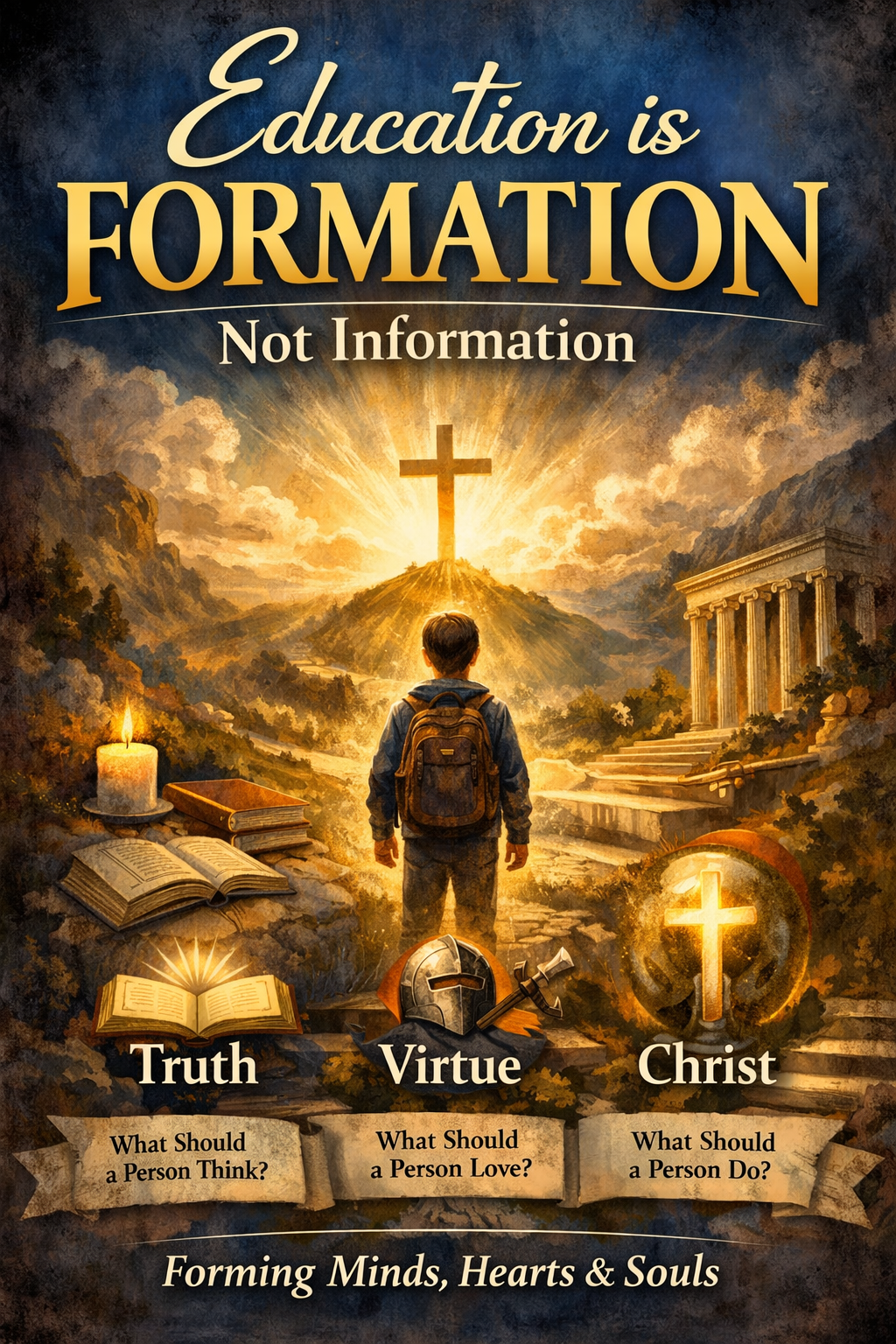
At the end of 13 years of schooling (Kindergarten through 12th) the primary question is not what does a student know, but who has the student become.
That is why a good education focuses on the
bringing up or the
rearing of a child. There are multiple facets to bringing up a child. One aspect does involve the intellect—the knowledge a child receives as well as the way he is trained to think. But a human child is more than just intellect. People are not “brains on a stick.” Humans are not even primarily intellect. Their intellect is just one part of what they are.
Another part of the human child is his desire—his passion. The heart of a person is at least as important, probably more important than the brain of a person, so to speak. Asking,
“What does a person desire?” tells you more about that person than asking, “What does a person think?”
So, the intellect is one part of the person. Passion, or desire is another part. And a third part to consider is the person’s will, most visible in the actions of a person. Ask, “What does a person do?”
Three questions:
What does a person think?
What does a person want?
What does a person do?
Well, any person might think, want, or do any number of things. That’s where education comes in. Educators add the word
should
to the three questions. What
should
a person think? What
should a person want? What
should a person do? Every school, and every education system has either a spoken or an unspoken answer to those questions. Let’s look at the obvious answers society’s school use.
What should a person think? They should think what has been deemed socially acceptable. What society has told them to think (about sexuality, politics, social justice, economics, environment etc.)
What should a person want? They should want whatever satisfies them the most. They should be true to themselves. THey can have a whole range of wants, and a consumer society bent on materialistic things will want all sorts of things: clothes, shoes, cars, careers, status, titles, fame, fortune, etc.
What should a person do? A person should do what feels right to them. Whatever pleases himself, that is what a person should do.
In short, the formation of a student in the world’s school system produces citizens who are generally selfish and easily manipulated. That is not the form we want our students to grow into.
In Christian Education, the answer to these three questions is entirely different. The answers we have direct the minds, passions, and wills of young people towards the good, the true, and the beautiful. Every person has a conception of what the ‘good life’ is. Imagining the good life for some brings pictures of wealth, houses, cars and possessions. For others, good life imagery includes family, friends, and relationships. Some people might imagine trips, travel and vacations, others picture a stationary life, staying in the comfort of what is known and familiar. Even still others picture parties and unrestrained fun.
Every human being longs for the good life. But each could have varying misconceptions about what makes up the good life. As Bible-believers, we understand the good life is only accessible through a relationship with God that molds an individual into the form of God’s Son. The good life is the virtuous life. The fulfilling, purpose-filled life is the life lived exactly as God intended it to live. Living and operating the way God made us to live and operate is exactly how I would describe the essence of virtue. The excellence of man is to bear the image of God, showcasing God’s excellence. “That ye should shew forth the praises of him who hath called you out of darkness into his marvellous light.” 1 Peter 2:9
So then, the goal of Christian education is not just to inform students, but to form students into virtuous citizens of heaven. How can we do that? With these three components:
Veritas - Students must become acquainted with truth. To live the good life, individuals must have an ear for truth and an eye for beauty. True beauty. Objective beauty. Not this ‘beauty is in the eye of the beholder’ beauty. That is simply attraction. And as the world shows us, people can be attracted to some awful things. Attraction is like appetite. The more junk you consume, the more your appetite for junk grows. This is true about junk food as it is true about the junk of life. True beauty is that which directs our eyes to God, the sum of all beauty. A brilliant sunset, a majestic mountain range, or a pleasant meadow all have intrinsic, objective beauty that point to the Creator and all beauty. Students need to have a daily diet of truth and beauty. They need to feast their eyes on beauty and their ears on truth. That way they develop an appetite for the true and the beautiful, an appetite that can ultimately only be satiated by God himself. “As the hart panteth after the water brooks, so panteth my soul after thee, O God. My soul thirsteth for God, for the living God: when shall I come and appear before God?” Psalm 42:1-2
Daily turning the eyes and ears of students to truth and beauty is the first vital component of an education that forms as it informs.
Virtus - Second, training students to exhibit and practice virtue. You don’t wake up one day and then just choose to be virtuous. Well, maybe you do wake up and decide that you want to be virtuous, but that doesn’t immediately make you a virtuous person. Virtue must be cultivated with habitually virtuous actions.
You cannot choose to just be virtuous, your virtue is determined by your habits. You don’t even necessarily choose your habits, those are determined by the actions that you make day after day. But you do choose your actions. And in choosing the right actions day after day, you form good habits, and a person who has many good habits because he daily chooses good actions is well on his way to becoming virtuous. Put succinctly, to become habitually virtuous, you must practice virtuous habits.
An education fixated on formation will direct students and provide opportunities to regularly practice good habits. Those practices may be unnatural at first, and may even be uncomfortable for children, but as with all habits, the more you practice the more ingrained and natural they become. Students spend up to a decade and a half in school. The habits they form in that period are the habits that form them for the rest of their lives. Education is formative, but the chosen form is important. We want our students to practice good habits. The patterns they set now mean something. Ultimately, we want students to pattern their lives after the virtues of Christ.
Christus - This last point is the most important one, for it is the foundation of the first two. Training in truth and virtue can never be fulfilled if it doesn’t begin with faith in Christ. One can try to be courageous and just, but will always fall short of perfection. Jesus is the only one who was perfectly virtuous. It is only in and through Him that our virtue can be perfected.
Placing faith in Christ and His work is the starting place. But definitionally, a starting place is not the end. That’s why we are commanded to “add to our faith” virtue and knowledge so that God can perfect and finish in us the work that He began on the cross.
FBA's Vision Statement: FORMING STUDENTS INTO THE IMAGE OF CHRIST BY TEACHING THE TRUTH AND TRAINING IN VIRTUE.